All posts · Updated · 7 min read
Puzzle Games with Voice Chat for Playing with Friends
Play puzzle games with voice chat, plan smart moves in fair live duels, tackle shared Daily puzzles, and challenge friends to beat your score—on your terms.

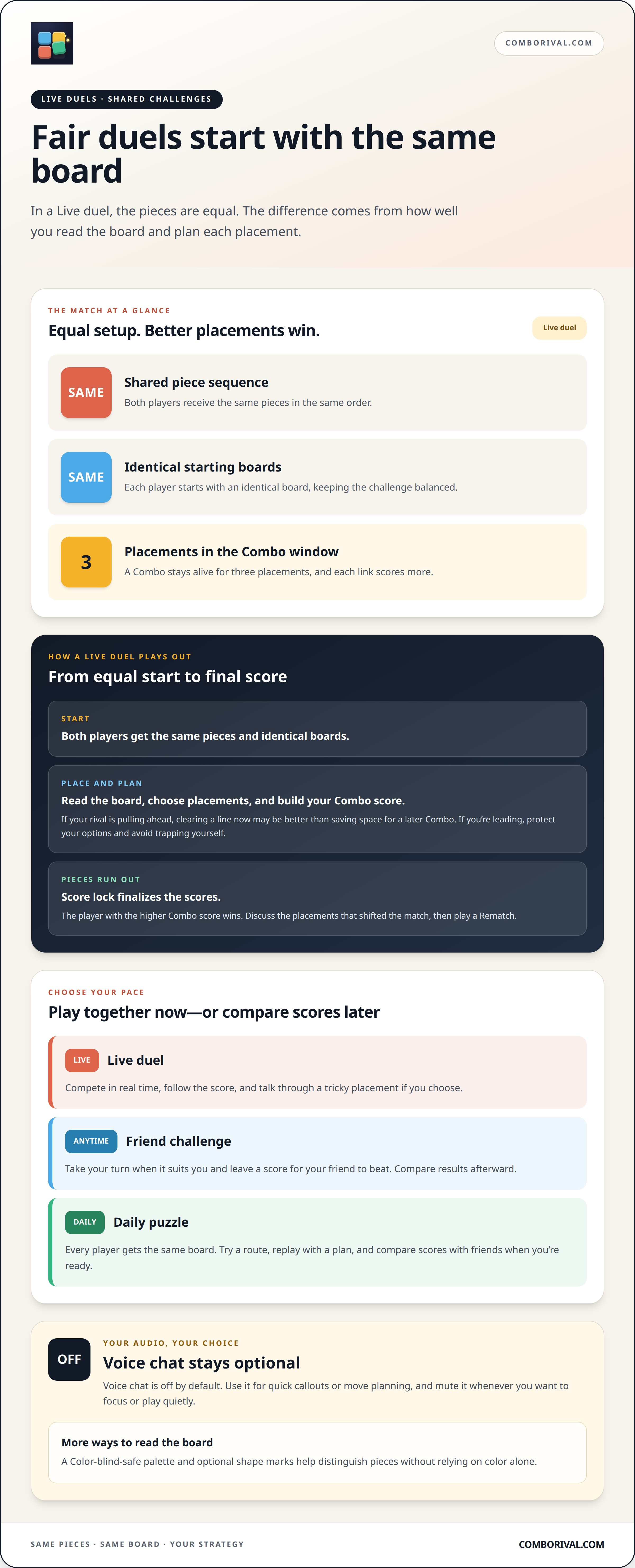
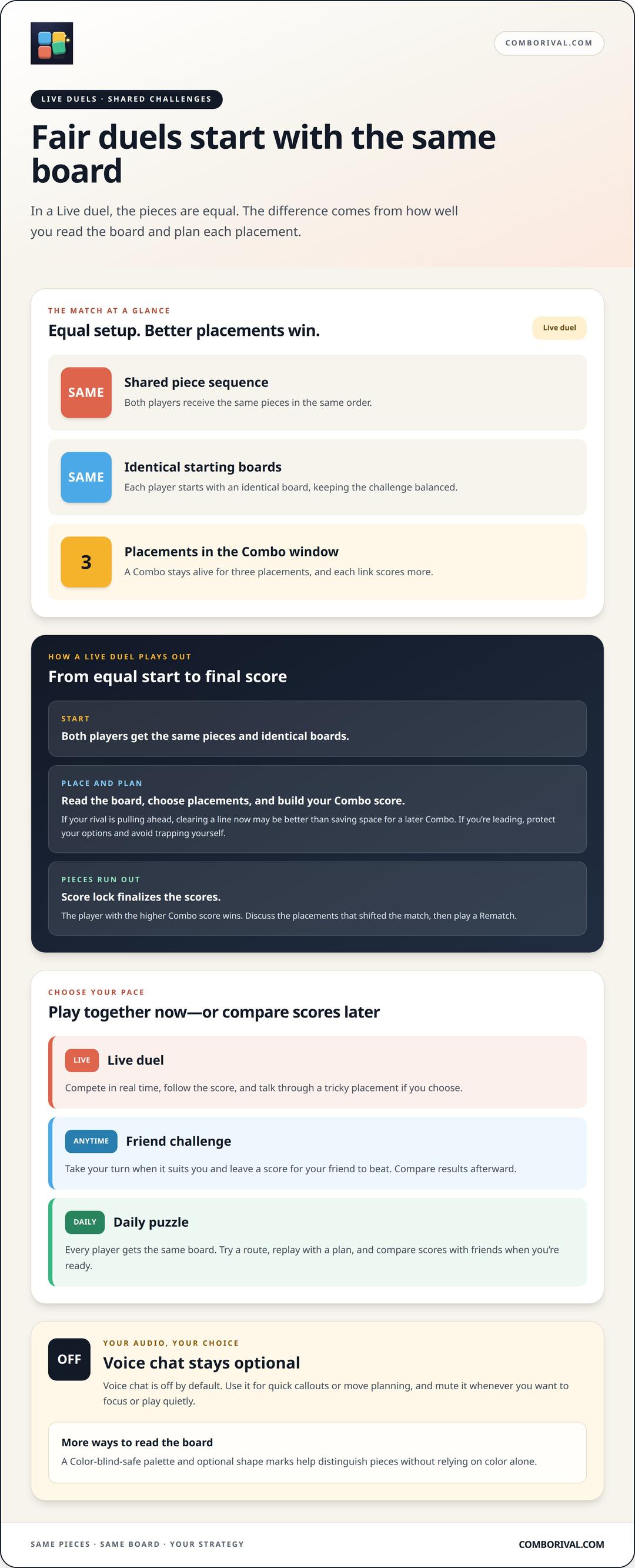
A fair puzzle duel comes down to smart placements, not a better deal: puzzle games with voice chat let you talk with a friend while you play, plan moves, and chase the next clear. In a balanced match, both players get the same sequence of pieces and start with identical boards.
The fun is spotting a move your friend missed, then trying to beat their score. Voice chat adds quick callouts and friendly banter, while the controls keep it on your terms: it’s off by default and you can mute it at any time.
Here, you’ll learn what voice chat adds to live and anytime friend duels, how shared pieces support a fair challenge, and what to expect from puzzle games with voice chat when you want to solve, compete, or just trade scores with a friend.
Key Takeaways
- Use voice for quick callouts, move planning, and friendly banter while you solve together.
- Explore color-blind accessibility options to make board details easier to distinguish.
- Set up an anytime score challenge or take on the shared Daily puzzle when you can’t play at once.
- Try Combo Rivals: Block Puzzle for friend matches, daily challenges, and optional Season Pass tracks.
Table of Contents
- Puzzle Games with Voice Chat
- Voice Chat Controls and Accessibility
- Live Duels and Fair Competition
- Challenges and Daily Puzzles
- Combo Rival: Combo Rivals: Block Puzzle
Puzzle Games with Voice Chat
Puzzle games with voice chat add live planning, not a shortcut through the puzzle. As you scan a block board, tell your friend, “Save that corner for the long piece,” or ask them to watch for a clear on the left. Those callouts turn silent placements into shared decisions. The U.S. Bureau of Labor Statistics lists playing games over the Internet as a playing-games activity, useful context for friends connecting remotely.
Voice chat lets you explain a move in the moment. If your friend places a piece too early, point out the open row before their next turn. Spot a better fit? Describe the shape and target gap instead of waiting for a text reply. Keep comments short as the board changes. Call out the risky slot or the clear you’re setting up, then let your friend make the play. The puzzle stays in their hands.
A useful way to make voice chat support the puzzle is to treat it as a place for noticing and explaining, rather than issuing instructions. The U.S. Consumer Product Safety Commission says children enjoy matching and memory games that require them to follow a set of actions in a pattern. In a shared game, a player can say what pattern they think is emerging, describe the image or shape they are trying to remember, or ask a friend to confirm a match before committing to it. That kind of talk keeps attention on the game’s clues while giving each player room to make a decision. A calm prompt such as “Look at the two shapes near the edge” invites someone to inspect the board; a command to make a move can take the choice away from them. Let the person holding the turn decide after hearing the suggestion. If the callout is mistaken, treat it as a chance to look again rather than a reason to criticize. A puzzle can then become a conversation about what the board shows, with each player contributing observations at a comfortable pace. When a pattern is hard to explain, describe a useful feature, such as its color, position, or direction, and pause so the other player can find it. Clear descriptions are more helpful than several guesses delivered at once. Voice chat works best when the words point attention toward the puzzle, not away from it.
This approach also helps when someone is learning to follow a sequence. Say what you notice, then give them time to compare it with the board and choose a move. If they miss a match, ask which detail they were watching; if they spot a pattern, invite them to explain how they recognized it. These questions make the reasoning audible without turning the call into a test. Keep the conversation focused on the next clue or decision, especially when someone is concentrating. A brief pause can be more useful than filling every quiet moment with advice. Before the puzzle gets busy, agree on simple callouts: a phrase for a possible match, a way to flag a tile worth remembering, or a gentle request to look again. Use familiar wording consistently, and change it if it causes confusion. A spoken reminder can help everyone focus on the same part of a sequence, but each player should do the remembering and make their own choices. In a matching game, describe the feature that seems important without giving away the answer right away. If a friend asks for help, offer a hint that narrows their attention while leaving the solution for them to find. The goal is shared focus, not a perfect run. Give everyone room to ask questions, correct misunderstandings, and pause before the next move. When players explain what they see and listen to each other, voice chat supports teamwork while the players remain in charge of solving.
Voice Chat Controls and Accessibility
Voice chat is off by default, so a match begins quiet unless you choose to speak. Turn it on when a friend’s callout helps, then mute it whenever you want to focus on the board or play without conversation. That control keeps audio optional, not part of the puzzle’s demands. In a live duel, talk through a tricky placement, then mute the channel while you line up your next move.
Combo Rival’s Color-blind-safe palette and optional shape marks help you read the board without relying on colour alone. Turn on shape marks in Settings to add a symbol to each colour. If two shades look similar, use the symbols to tell them apart before choosing where a piece fits. These cues give you another way to scan open spaces and plan a clear. Choose the visual settings that make the board easiest for you to read, then focus on placement and timing.
Live Duels and Fair Competition
A Live duel puts you and a friend on the board at the same time, turning each placement into a direct contest. Both players receive the same pieces in the same order, so the winner is the one with the higher Combo score. A Combo stays alive for three placements, and each link scores more. If your rival is pulling ahead, you might clear a line now instead of saving space for a later Combo. If you’re leading, protect your options and avoid trapping yourself with an awkward piece. The result comes down to how well you read the board and plan your placements.
When the pieces run out, Score lock finalizes the scores and the result is clear. Discuss the placements that shifted the match, then tap Rematch to play again. Voice chat can carry the post-match banter into the next round. Friend duels keep the format straightforward: compete in real time, follow the score, and see who made better use of the board.
Challenges and Daily Puzzles
An anytime friend duel lets you compete without coordinating a live session. Take your turn when it suits you and leave a score for your friend to beat. With time between turns, you can focus on a clean run, while your friend can try a different approach. Compare results afterward and talk about the placement that made the biggest difference. Rematch when you’re both ready.
The Daily puzzle gives players the same board, making it a shared challenge even when you solve at different times. Try one route, note where space gets tight, then replay with a plan that protects open rows. Compare scores with friends afterward and discuss which moves worked. It’s a low-pressure way to keep a rivalry going between live matches, without coordinating schedules or calling out moves in real time.
Combo Rival: Combo Rivals: Block Puzzle
Combo Rival’s Combo Rivals: Block Puzzle is a free mobile game for friends who want a direct block-puzzle matchup. Choose a live 1v1 duel when you’re both ready, or an anytime friend duel when your schedules don’t line up. Voice chat lets you call out a tight gap, debate a risky placement, or celebrate a clean clear as the board changes.
Want a challenge without matching schedules? Take on the Daily puzzle challenge and compare scores with friends on the same board. The Season Pass has free and premium tracks. Pick the format that fits the moment: live play for immediate rivalry, anytime duels for flexible score chasing, or the daily board for a shared puzzle to solve on your own time. For questions or feedback about the game, contact Combo Rival.