All posts · 9 min read
1v1 Block Puzzle Battle Strategy for Smarter Line Clears
Use a 1v1 block puzzle battle strategy to plan line clears, manage board space and make smarter moves in live duels or asynchronous score challenges too.

A strong 1v1 block puzzle battle strategy starts with planned placements and a clear read of the board, not panic clears. Duel formats, line clears, incoming pieces, and board space all shape your choices, so each move needs a purpose.
Focus on the next useful placement and make the board work for you.
Key Takeaways
- Choose a live duel for direct, real-time rivalry or an anytime score chase when you want to play on your own schedule.
- Build line clears around your next placements, not just the points you can score right now.
- Use the shared piece sequence to focus on decisions you control instead of blaming the draw.
- Keep flexible gaps on your board so incoming pieces don’t leave you with nowhere to place them.
Table of Contents
- Choosing between real-time duels and score chases
- Clearing lines and attacking opponents
- Whether opponents receive the same pieces
- Board management in versus matches
- Combo Rival
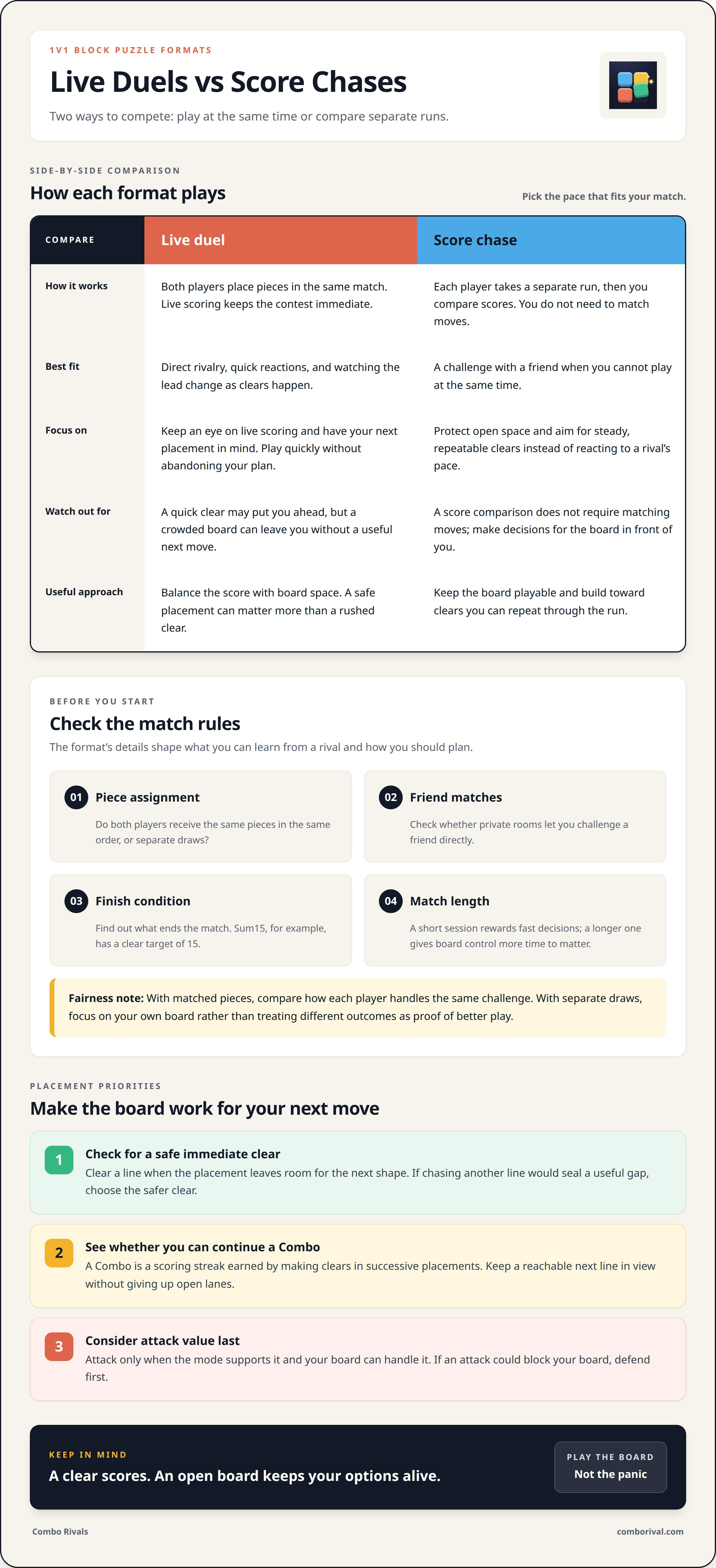
Choosing between real-time duels and score chases
Block-puzzle games with 1v1 modes include Sum15 and Block Battle. In Sum15, the first player to reach a total of 15 wins. Block Battle players can progress through leagues, from Bronze and Silver to Gold, Platinum, and higher.
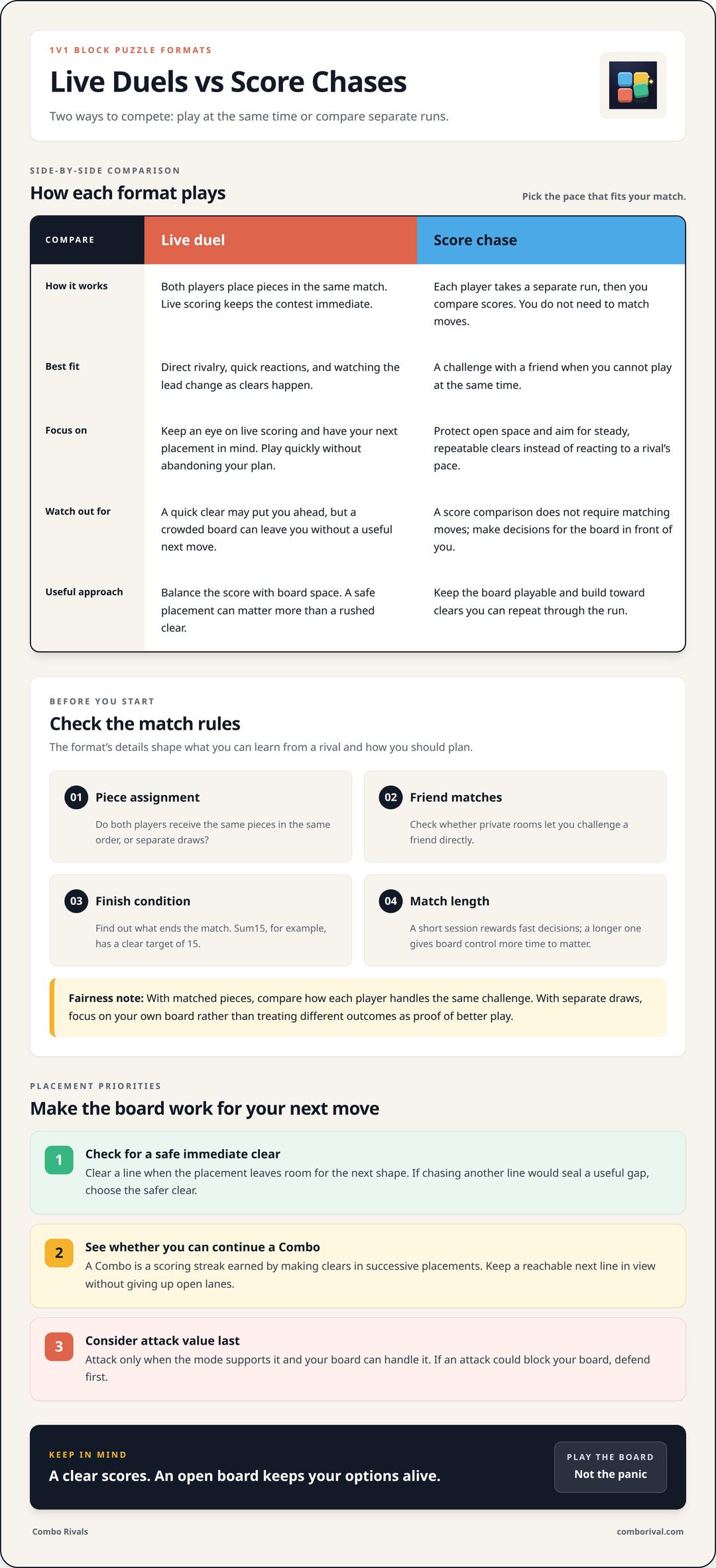
Choose a live duel when you want both players active in the same match. You place pieces while your rival does the same, and live scoring keeps the contest immediate. Each clear can change who leads. A quick line clear may put you ahead, but a crowded board could cost you the next move. Play quickly without abandoning your placement plan.
Choose a score chase when you and a friend can’t play at the same time. Each player takes a run, then compares scores, so there’s no need to match moves. Focus on a clean board and steady clears instead of reacting to your rival’s pace. This format suits players who want a challenge on their own schedule.
Before a duel, compare its rules, not just its name. Ask whether the game uses the same pieces for both players or leaves piece order to chance. Check whether private rooms let you challenge a friend directly. Find out how a match ends: Sum15 has a clear target, while other modes may use another finish condition. Match length matters too. A short session rewards fast decisions; a longer one gives board control more time to matter.
- Choose live play for direct rivalry and quick reactions.
- Choose a score chase for flexible, separate runs.
- Check piece fairness, private-room access, and the end condition before starting.
Then shape your 1v1 block puzzle battle strategy around the format. In a live match, watch the score and keep your next placement ready. In a score chase, protect open space and aim for repeatable clears. Block Battle’s leagues add another goal: wins help players earn coins for entry into higher leagues. Pick the mode that fits your time, then play the board in front of you.
Clearing lines and attacking opponents
Attacks, defense, and Combo serve different purposes. An attack can pressure a rival when the mode supports it. Defense keeps your board playable. A Combo is a scoring streak earned by making clears in successive placements, so it can boost your score without forcing risky moves.
In 1v1 block puzzle games, scoring usually rewards cleared lines. Some modes also reward consecutive clears or connect clears to attacks. The exact points and attack effects depend on the mode’s rules. Read those rules before your first move, then watch live scoring to see whether a clear changes your score, your rival’s board, or both.
Attack only when your board can handle it. If a piece completes a line and leaves space for the next shape, make the clear. If chasing another line would seal a useful gap, take the safer clear instead. A completed row may be better than a setup that leaves a narrow, awkward slot.
Survival depends on keeping placement options open. Preserve a wide area for larger shapes, and avoid building tall, uneven columns. Before placing a piece, scan the available shapes. Ask whether the move clears a line, preserves room, or creates a dead end. If it does none of these, look for another placement.
Beginners often chase a big clear, ignore the board edges, or place a shape without checking its fit. These mistakes can trade a safe line for a cramped board and break a Combo by leaving too many placements between clears. Make a clear, then look for the next reachable line without giving up your open lanes.
Use this decision order: check for a safe immediate clear, see whether another placement can continue your Combo, then consider attack value. If an attack could block your board, defend first. A steady clear keeps you scoring and leaves room for your next piece. A flashy move that ends your run can give your rival an opening.
Whether opponents receive the same pieces
Piece fairness depends on the game’s rules. Before competing, find out whether both players receive the same pieces in the same order or get separate draws. That affects what you can learn from a rival’s moves. With matched pieces, compare how each player handles the same challenge. With separate draws, focus on your own board rather than treating different outcomes as proof of better play.
Treat your rival’s moves as information, not a script. If they clear a line, note the open space that made the placement work. Then check whether your current shape gives you a similar option. Don’t copy a move blindly: a small difference in board layout can make the same placement smart for one player and risky for another.
AI opponents can help you practice reading shapes and testing placements. Treat a win as a useful run, not proof that a tactic will work against everyone. Try a different opening placement and see how it changes your available space. This keeps practice focused on decisions you control instead of guesses about how the computer chooses moves.
Ranked play makes each decision feel more consequential. Keep your approach steady when a result affects your standing. After a loss, identify the placement that reduced your options and adjust that choice next time. Don’t change your whole plan because one opponent played quickly or scored first. Focus on legal fits and the board in front of you.
Before a ranked match, read the rules for piece assignment, opponent type, and scoring. If both players don’t get equivalent draws, judge your performance by board control and completed lines. If they do, use the match to compare placement choices. Either way, separate a strong decision from a result shaped by the mode.
Board management in versus matches
In a versus match, weigh space against points with each placement. Keep open lanes where several shapes can fit, and avoid isolated gaps that accept only one awkward piece. A single empty square beneath a filled row, for example, can become dead space. Clear nearby lines before that pocket spreads.
To improve your chances, scan the current piece, the open board, and your likely next placement before moving. Keep columns at similar heights when possible. If one side grows taller, fill it with a suitable shape before the gap gets harder to reach. This preserves more placement options and can help you outlast your opponent.
Use a power-up only when the mode offers one and it solves a real board problem. It may help when it clears space for a piece that otherwise has no safe fit. Don’t spend one just to gain a few points while your board is still open.
Build a repeatable check before each placement: find a safe fit, look for a line clear, then review the remaining open lanes. If a move completes a row but blocks your only space for a large shape, weigh that cost against the clear. In a close match, playable space can matter more than a quick score boost.
- Keep gaps connected to open areas, not sealed pockets.
- Lower a tall column before it limits your available fits.
- Choose a power-up for a clear purpose, such as restoring room.
Strong board control comes from choosing placements you can build on. Put these habits to work in a match with a smarter placement plan.
Before settling into a versus routine, check whether the duel gives both players the same pieces, whether private rooms are available, and how long matches last. Use those details to shape your approach. If the pieces differ, stay flexible and judge each placement by the space available. If private rooms are available, use one for a deliberate match with someone you choose. Keep match length in mind as you balance safe placements and scoring opportunities. Understanding the format helps you make decisions that fit the duel you’re playing.
Combo Rival
Combo Rival puts these board-management ideas into practice. The mobile block puzzle game offers live and anytime friend duels, so you can play a direct match or challenge a friend on your own schedule. Both players receive the same sequence of pieces, putting the focus on placement choices.
Prefer solo practice? Try the Daily Puzzle to tackle a shared board. Test how you protect open space, set up clears, and handle awkward shapes, then take those habits into a duel. You control each move, whether you’re practicing alone or facing a rival.
Want to discuss your next match? Contact Combo Rival.
Put your next move to the test
Use your next match to sharpen one decision. Choose a focus before you start: leave more open space, avoid rushed placements, or preserve a clear route for awkward shapes. After the match, think about the move that changed your board. Keep the lesson and drop the habit that boxed you in.
A stronger 1v1 block puzzle battle strategy comes from noticing patterns, not chasing a perfect run. Try one adjustment at a time. That makes it easier to see what helped and what needs work. Bring a friend into the next duel, or ask the team behind Combo Rival, with its game expertise, a question. Keep the rivalry friendly and the next move yours.
Contact Combo Rival to start the conversation.
Frequently Asked Questions
What are the rules of a 1v1 block puzzle battle?
Rules vary by game mode. Check how pieces can be placed, what counts as a completed line, and what ends the match. Some games set a target score; others compare final results when play stops. If a piece has no legal fit, the mode’s rules determine what happens next. Read these conditions before your first move.
How should you place blocks to clear multiple lines efficiently?
Study a shape’s footprint before placing it. Look for a position that fills gaps in more than one row or column, then check whether the surrounding cells can still fit upcoming shapes. A broad piece might complete two nearly full rows across their shared gap, for example. Don’t force the fit if it creates a single-cell pocket elsewhere.
How can you send attacks or garbage blocks to your opponent?
Plan around attacks only if the game’s rules describe them. Look for a clear trigger, such as a named action or an on-screen attack indicator, before expecting garbage blocks. A line clear doesn’t automatically send anything to your opponent. In modes without attacks, focus on your score and board instead of expecting to disrupt the other player.
How do you manage the board and avoid getting trapped?
Check usable board space, including narrow lanes and corners, before placing a shape. If a piece fits only by sealing off a large area, weigh that fit against the space it removes. Placing a block along an edge, for example, may preserve a broad central area for varied shapes. Reassess after each clear because the board’s usable routes change.