All posts · Updated · 9 min read
How to Avoid Dead Space in Grid Puzzles and Keep Moves Open
Learn how avoiding dead space in grid puzzles keeps moves open: scan offered pieces, track final empty cells, and clear lines without creating unusable gaps.
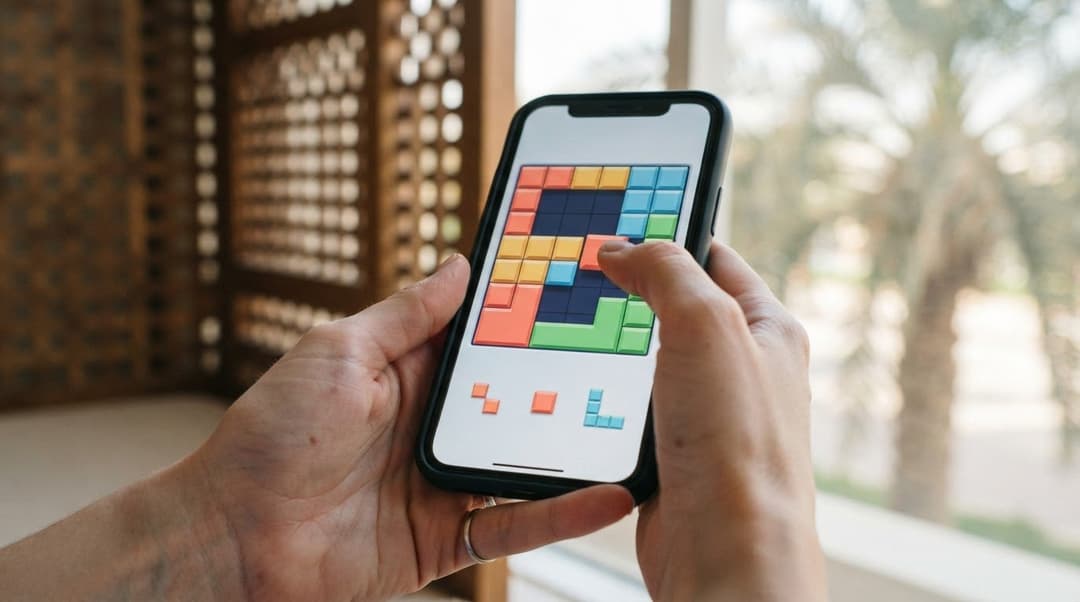
Dead space doesn't appear all at once; it builds when a placement splits open cells into scraps your next pieces can't use. Avoiding dead space in grid puzzles means checking the board before each move: read all three offered pieces, spot the line's last open cell, and look for a clear that keeps usable space connected. A crowded board can still have room for strong plays, while scattered holes can block a piece you need, so plan backwards from the lines you can finish and place blocks where they preserve room to move.
Key Takeaways
- When a board feels stuck, scan for a missed placement before committing to another move.
- Track the final open cell in a row or column so a near-clear doesn’t turn into a trap.
- Work backwards from the finish to spot placements that keep a route open.
- Choose clears that leave connected room for future pieces, not scattered gaps.
Table of Contents
- Checking for mistakes when stuck
- Finding a row or column's last open cell
- Planning backwards from the finish
- Choosing line clears that preserve contiguous space
- Combo Rival
Checking for mistakes when stuck
Pause and review your placements before filling another gap. Algorithms can detect unreachable cells by mapping legal moves and checking which cells remain accessible. In a block-placement puzzle, also check whether the available pieces still fit.
Review moves for mistakes
Replay your recent placements in reverse, starting with the move that first narrowed the board. Did a block cover a useful opening or leave isolated cells that no available shape can fill? If a square piece no longer fits, inspect the gaps created by that move. Correct the first risky choice, not just the final jam.
Detect unreachable cells
Mark each open cell, then trace the legal connections between them. In a movement puzzle, follow every allowed direction from your current cell. Any cell with no legal route from your position is unreachable. In a jump puzzle, check the destination before committing: a landing cell can become a dead end if its jumps are blocked or leave the grid.
- Scan each row and column for a single open cell. That final gap may reveal a missed clear or placement mistake. In a logic grid, compare the remaining options with every clue, including comparisons between ages or other ordered values. If only one candidate remains, confirm that the clues support it before marking the cell. One mistaken mark can distort later deductions.
- Test the next move before locking it in. Check whether the destination allows a legal continuation, or whether an available block will still fit after the placement. Watch narrow gaps: a single-cell opening may look harmless but strand a larger piece. If no viable move remains, retrace the sequence to find where the open space split.
When stuck, revisit each comparison clue using only the ages that remain possible. Check that the clue still holds for those candidates. If it does not, reconsider the related mark rather than carrying the mismatch into later deductions.
Before committing to a jump, check the destination cell and verify that at least one legal next move is available. If there is no continuation, choose a different jump to avoid a dead end.
Finding a row or column's last open cell
Scan each row and column before placing a block. A line with one open cell may reveal an opportunity to clear it, but filling it carelessly can close useful space elsewhere.
Constraint-based strategies narrow choices by applying the rules for each row, column, box, or category. In Sudoku and logic grids, they can reveal forced cells before a guess leads to a mistaken mark.
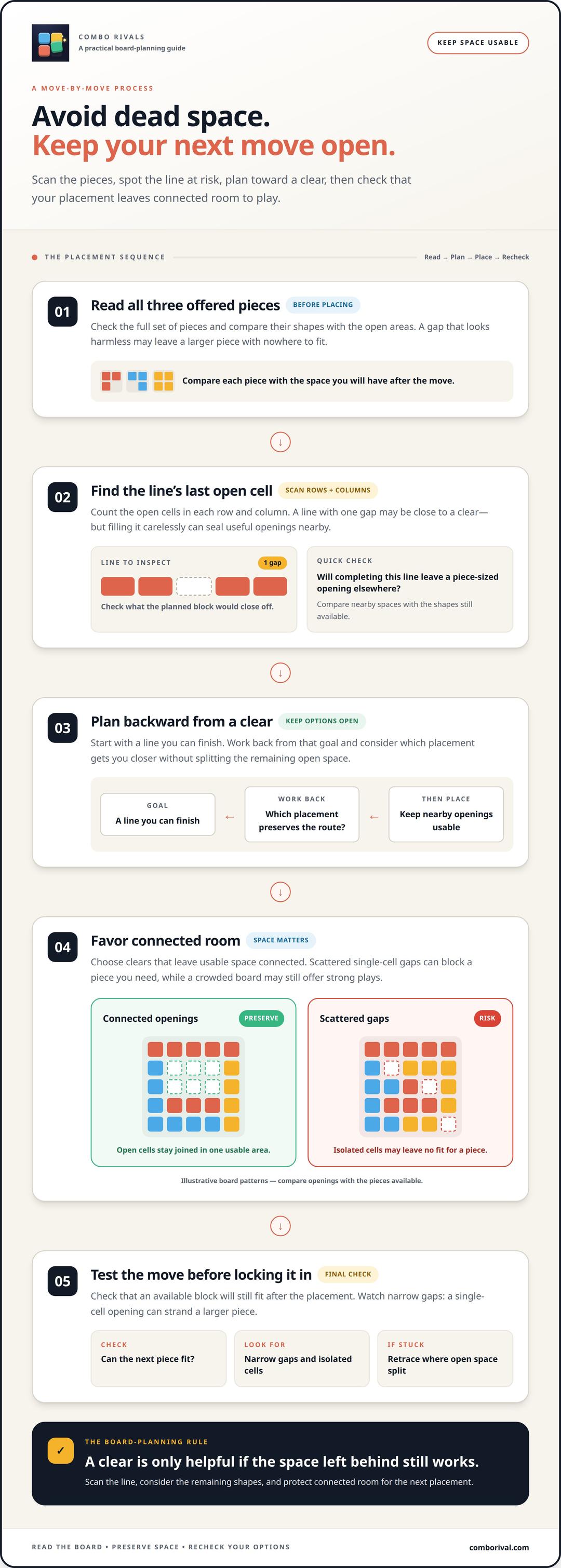
- Count the open cells in each row and column. Start with the line closest to completion and mark every empty cell. If a row has one gap, check that your planned block fills it without sealing nearby openings. A quick visual count can catch a missed cell before the board gets tighter.
- Compare each candidate with the constraints that intersect at its cell. In Sudoku, a value ruled out by its row or column cannot go there. In a logic grid, a confirmed pairing rules out other options in its row and column. Use these exclusions to narrow the candidates, not to force a choice the clues do not support.
- Prioritize a line with only one legal option. If every cell in a row is filled except one, test that final cell against its column and box. In a logic grid, check whether only one pairing remains after applying the direct clues. A forced cell follows from the current constraints, making it safer than a guess.
- Before completing a line, inspect the spaces beside its last opening. A clear can help, but a placement that leaves scattered single-cell gaps may block a later piece. In a block puzzle, compare the remaining openings with the available shapes. Keep a connected patch open if completing the row or column would split the board into narrow pockets.
In a logic-grid puzzle, each cell represents a proposition, such as whether a person was in a particular room. Mark cells as ruled out, confirmed, or open. If you get stuck, check rows and columns for a single remaining empty cell. A mark in one block can also inform other blocks that share its row or column.
In a perfect maze, every cell is reachable and there are no loops. A corner cell has at most 2 possible jump directions before accounting for its jump value.
Planning backwards from the finish
In a Number Maze, work backward from the bottom-right finish toward the top-left start. This check shows which cells can reach the goal and helps you preserve a valid route.
- Mark the finish cell first. To avoid dead space in grid puzzles, start at the goal and identify cells that can reach it in one legal jump. Treat these as possible final moves, not automatic choices. Keep each candidate visible as you trace a route toward the start.
- Test each candidate against its jump value and the movement rules. A cell belongs on the route only if it can be part of a legal chain to the finish. Reject jumps that leave the grid. This check is especially important near corners, where fewer directions are available than in interior cells.
- Continue tracing backward from each possible landing cell. Ask which earlier cells can legally reach it, then mark them as possible predecessors. If two cells can reach the same landing, keep both options open until another clue rules one out. This maps the cells that may form a route from the start.
- Compare the backward chain with your forward route before moving. Every landing must follow a legal jump, and the route cannot revisit a cell. If your path enters a cell outside the goal’s backward chain, the finish may no longer be reachable. Reroute before that move cuts off your remaining options.
- Record each branch as you test it. Mark visited cells once, then cross out any branch that breaks a movement rule or loops back. When avoiding dead space in grid puzzles, do not default to the path that looks shortest. A valid route must connect the top-left start to the bottom-right finish without revisiting cells or jumping beyond the grid.
Choosing line clears that preserve contiguous space
Dead space has different meanings in block puzzles, mazes, Sudoku, and logic grids. The rules determine whether an empty cell is unusable, isolated, or still part of a valid route.
Check how puzzle rules define dead space
Read the move rules before judging an empty cell. In a block puzzle, a gap is a problem when no available piece fits. In a Number Maze, a cell is unusable if no legal jump connects it to the finish. Sudoku and logic grids follow different constraints: empty cells remain candidates until their row, column, box, or clues rule them out. A space that looks blocked is not automatically dead.
Identify dead space before placing or drawing
Pause before each placement or line, then trace what remains reachable. In a block puzzle, compare the open area with the shapes you need to place. A board that is 40% full may still reject a 3x3 square when empty cells sit in scattered single-cell holes. Before drawing a maze route, check that the next cell still leads toward the exit under the allowed moves.
Prevent isolated empty cells
Keep neighboring openings connected whenever a clear gives you a choice. In block puzzles, preserve a clear 3x3 area where possible, and avoid leaving single-cell pockets that common shapes cannot fill. In mazes, don’t draw a line that cuts off the only passage to the exit. In Sudoku or logic grids, apply row, column, and clue constraints before marking a cell, so one unsupported mark doesn’t erase valid options.
- Compare the board before and after a possible clear. A board that is 70% full can still accept almost any piece when blocks are packed neatly against the edges, while scattered holes can make a less-full board awkward. Favor the clear that opens one connected region, not several disconnected scraps. Then check whether the remaining shapes can fit; if nothing fits, the run ends.
Combo Rival
Combo Rival gives you a block puzzle game where smart spacing decisions shape each run. Use the tactics here as you choose placements, protect open areas, and look for line clears in Combo Rival: Block Puzzle.
Want to test your board sense against a friend? Friend duels offer live and anytime 1v1 matches. Players start with identical boards and a shared piece sequence, so each move is yours to make. The daily puzzle challenge gives you another way to take on a board and sharpen your choices.
Pick the format that fits your next session, then focus on the board, not guesswork. Contact Combo Rival if you have a question about playing.
Take your next move with you
Make avoiding dead space in grid puzzles part of your approach to every new board. Treat each placement as a choice with consequences. Pause to see what the move opens, what it closes, and whether you will still have room for your next play. This habit turns a tight board into a fresh decision, not an automatic dead end.
Put your board sense to work in Combo Rival, a free-to-download mobile block puzzle game for head-to-head play. In Live Duels, both players receive a Shared piece sequence, so your choices and combo score decide the contest. Try a duel or explore the other puzzle modes, then see how your strategy adapts.
Contact Combo Rival to talk about puzzle play. The team brings expertise in competitive puzzle games. Then take that sharper eye into your next game.
Frequently Asked Questions
What are common mistakes that create unusable spaces in grid puzzles?
A common mistake is judging a gap by its appearance instead of testing it against the puzzle’s rules. In a movement puzzle, an empty cell may be cut off from every legal route. In a placement puzzle, a small gap may not fit any remaining shape. Before committing, check whether the space is accessible and whether a future move can use it.
How can I avoid dead ends in grid-based path puzzles?
Use dead-end filling: repeatedly find a cell or passage with only one open way forward, then rule it out unless it leads to the goal. After each pass, continue tracing from the start. This removes branches that cannot form part of a route while preserving paths that still connect to the exit under the movement rules.
What examples show effective dead-space prevention in grid puzzles?
In a maze, imagine a side corridor that ends at a wall without reaching the exit. Mark it as unusable, then trace the remaining route without passing through it. In a block puzzle, test a planned placement against the shapes still available. In both cases, judge open space by what the next legal move can do.