All posts · Updated · 8 min read
How to Avoid Gridlock in Block Puzzle Games with Smarter Moves
Avoid gridlock in block puzzle games with smart placement, useful row clears, and careful planning. Keep future moves open and learn when to use hints or undo.
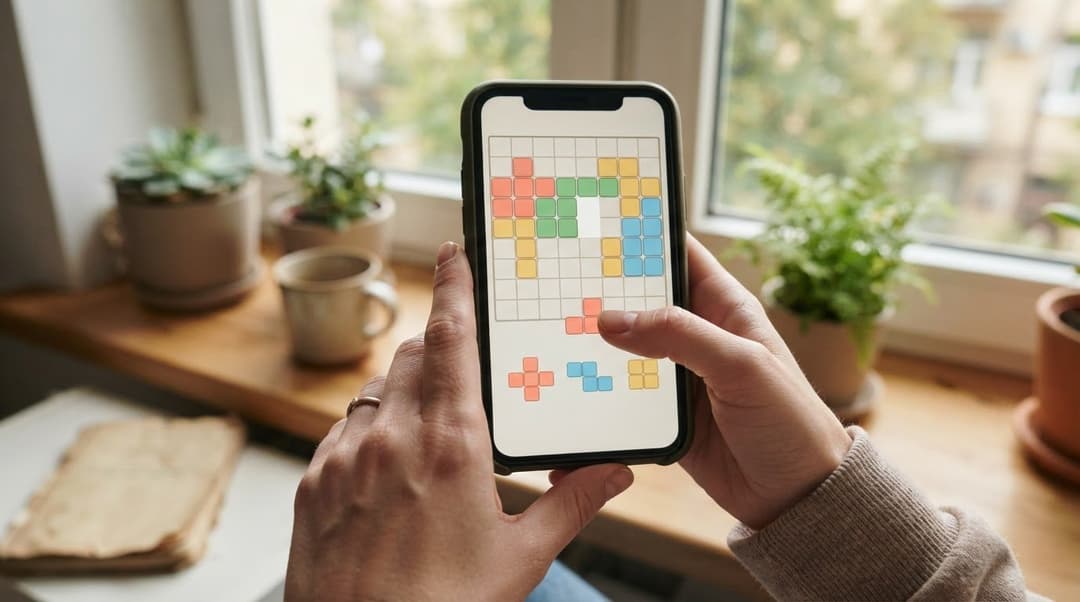
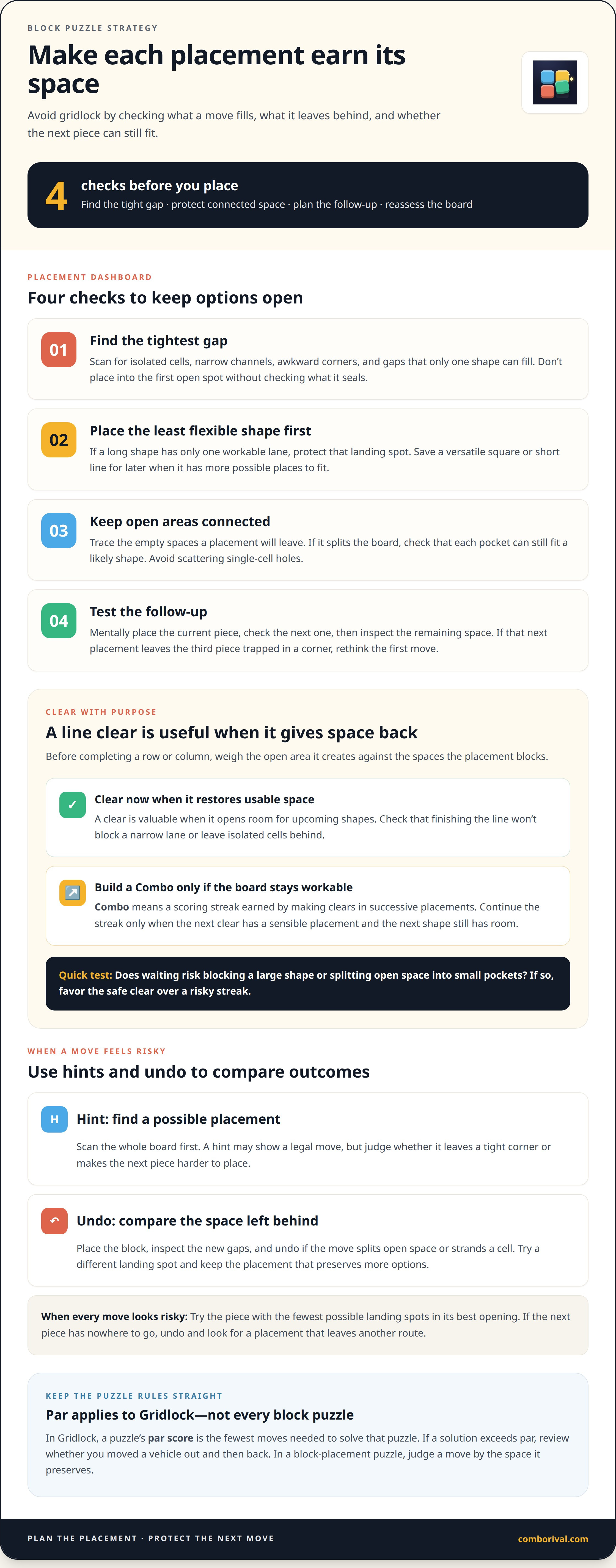
To avoid gridlock in block puzzle games, look beyond the piece in front of you: check where it fits, what space it leaves, and whether that space can accommodate the next shape. Keep open areas useful, and clear a row or column when doing so creates room instead of limiting your options.
A crowded board can make every move feel forced, but a quick plan gives you more control. Before placing a piece, scan the board for tight gaps, awkward corners, and lines you can complete without blocking future moves.
Learn to plan placements, clear rows or columns with purpose, and use hints or undo when available. Make each move earn its space, keep your options open, and give gridlock fewer chances to win.
Key Takeaways
- Use a puzzle’s par score to judge whether your route is efficient, not just whether it works.
- Review placements that undo earlier progress to spot moves you can cut.
- Clear rows or columns when the open space they create will help with upcoming pieces.
- Use hints or undo to test a risky placement before it leaves your board boxed in.
Table of Contents
- Puzzle difficulty and move counts
- Avoiding wasted moves
- Clearing complete rows or columns
- Hints and undo tools
- Combo Rival: Combo Rivals: Block Puzzle (free mobile game)
Puzzle difficulty and move counts
- Start by identifying the game’s core rule. In Gridlock, vehicles cannot overlap or pass through one another, so each move must open a route. In a block-placement game, you fit shapes onto a fixed board and manage the empty cells. The mechanics call for different plans: trace a path in Gridlock, but preserve flexible space in a placement puzzle.
- Next, use move counts only where they apply. Most beginner puzzles in Gridlock can be solved in fewer than 15 moves. A Gridlock puzzle’s par score is the fewest moves needed to solve it. Treat par as a target for that puzzle, not a universal score for every block puzzle. For placement games, judge a move by the space it preserves.
- Before placing anything, study the Daily puzzle board. Every player gets the same board, making its layout useful for focused practice. Look for narrow gaps, isolated cells, and rows or columns close to completion. The challenge comes from how the board and available shapes interact, not from a published level label.
- If the game previews upcoming pieces, scan the full sequence before committing. A long shape may need a clear lane, while a square can fit into several open pockets. Without a preview, plan around the pieces you have and keep more than one suitable area open. That flexibility helps you avoid gridlock in block puzzle games.
- Match your pace to the puzzle. A constrained board takes longer to inspect than one with broad open space, so pause before a placement that closes a lane. In a timed match, make the same scan quickly: find the tightest gap, mentally test the next shape, then place. Speed matters only if the move still leaves room.
Avoiding wasted moves
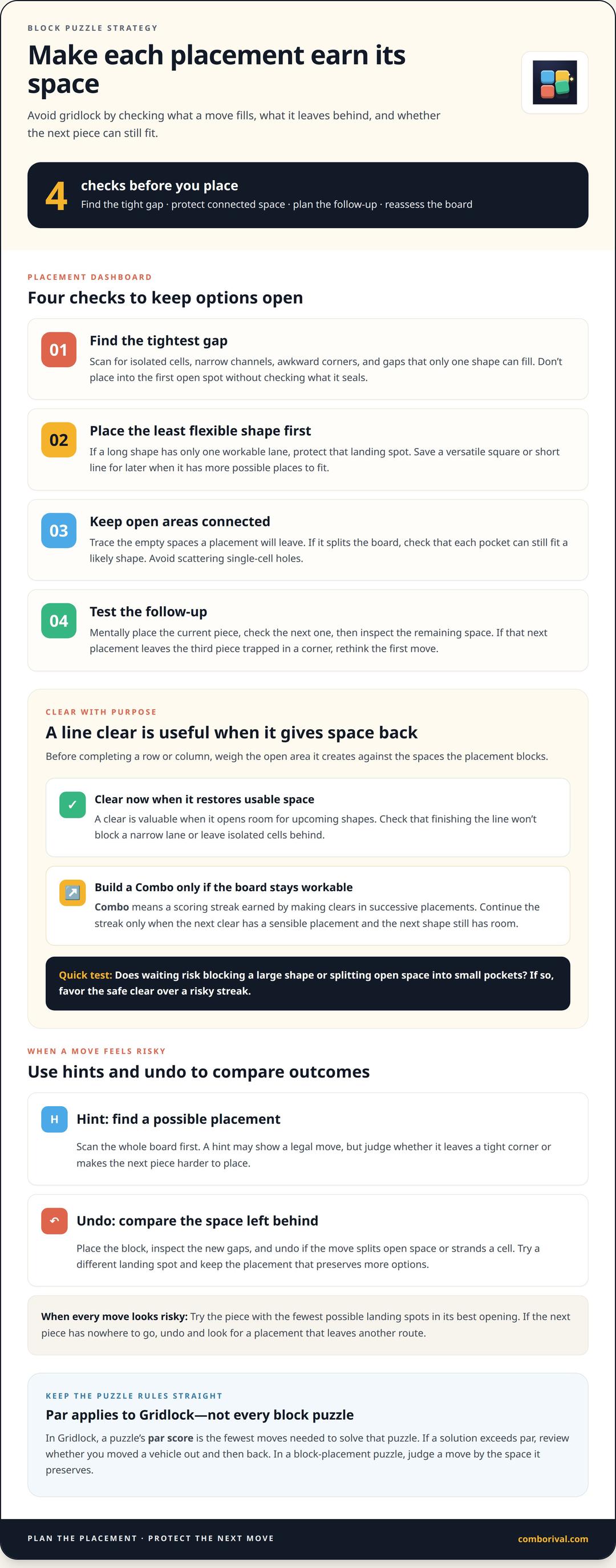
Reduce wasted placements by checking what each move changes, not just what it fills. Use these steps to spot traps, protect open space, and plan a useful follow-up.
Identify Causes of Gridlock
Scan for isolated cells, narrow channels, and gaps that only one shape can fill. Gridlock happens when the remaining pieces no longer fit, often because placements split open space or leave awkward holes. Don’t drop a block into the first available spot without checking what it seals. In a sliding-block Gridlock puzzle, moving a vehicle out and then back can reveal a wasted move.
Choose Which Block to Place First
Compare each available shape with the board’s tightest gaps. Place the least flexible block first if it has only one workable landing spot; save a versatile square or short line for later. For example, if a long shape fits one clear channel, placing a small square there may block it. Check the next piece as well, then choose a spot that keeps both options open.
Manage Board Space
Keep open areas connected instead of scattering single-cell holes across the board. Before placing a piece, trace the empty spaces it will leave. If filling the center separates the left and right sides, check that each remaining pocket can still fit a likely shape. Clear a row or column when the resulting space improves your options, not simply because a clear is available.
Plan Several Moves Ahead
Test a short sequence before committing: place the current block, check the next piece, then inspect the space left behind. If the second placement would force the third into a corner, rethink the plan and try another landing spot. This prevents moves that create no useful space. When a Gridlock solution exceeds par, check whether you moved a vehicle out and back.
Clearing complete rows or columns
Clear a line when the space it returns solves a problem on the board. Before chasing a Combo, consider whether waiting will leave you with fewer safe placements.
Spot Complete Lines to Clear
Scan each row and column for gaps you can fill without creating awkward spaces elsewhere. If a row needs one block, compare that opening with the available shapes. Completing the row may free room across the board, but if the placement blocks a narrow column, the clear could trade one problem for another.
Consider the board’s overall shape, not just the nearly complete line. For example, if a long block can finish a row and open a landing area for a square, the clear sets up a useful follow-up. If it leaves isolated cells, wait and look for a safer line. A clear is most valuable when it restores usable space.
Choose Between Clearing and Combos
Clear a row or column instead of building a Combo when the board is running short on workable space. A Combo is a scoring streak earned by making clears in successive placements. Continue the streak only when the next clear has a sensible placement and won’t leave a shape with nowhere to fit.
For example, one move might complete a row now, while another sets up a second clear later. Choose the immediate clear if waiting would block a large shape or split open space into small pockets. Choose the setup if the next pieces fit the plan and the board stays open. Score matters, but keeping room for the next piece is better than risking a streak.
Before each placement, weigh the reward against the space left behind. A clear that opens a broad area may give you more options than a chain of clears that leaves tight corners. That trade-off helps you avoid gridlock in block puzzle games.
Hints and undo tools
If no move looks safe, pause and rescan the board and available pieces. Test a possible placement with undo if the game offers it, and keep the move only if it improves your options.
- Scan the whole board before using a hint. Look for a piece that fits a narrow gap, completes a useful line, or opens a larger area. A hint may point to a legal placement, but you still need to assess the space it leaves. For example, a long block might fill one gap but create a tight corner elsewhere.
- Use undo to compare outcomes, not to guess. Place a block, inspect the new gaps, and undo if the move splits open space or strands a cell. Then try a different landing spot for the same piece. This quick comparison shows which placement keeps more options available.
- When every visible move looks risky, prioritize the piece with the fewest possible landing spots. Try it in its best opening first. If the next piece then has nowhere to go, undo and look for a placement that leaves another route. Don’t fill a broad, flexible area with a small block that could fit in several other places.
- Use a hint after scanning the board yourself, especially when several rows or columns are nearly complete. Compare the suggested move with your plan: does it create room, complete a clear, or preserve a landing space for another shape? If it only fills cells without improving your next options, consider other placements before committing.
- Before ending a turn, review the board again. Check each available shape against the remaining gaps, including corners and narrow channels. If undo is available, reverse a move that leaves no workable fit. If not, choose the placement that preserves the most useful open space.
Put this scan-and-test routine to work in a block puzzle game.
Combo Rival: Combo Rivals: Block Puzzle (free mobile game)
Combo Rival gives you a place to put careful board planning into play. In Combo Rivals: Block Puzzle, you can take on the Daily puzzle or test your decisions against a friend in live and anytime 1v1 matches.
Friend duels use identical starting boards and the same sequence of pieces for both players. That shared setup keeps the contest focused on how you place each shape, clear space, and respond to the board. Voice chat lets you talk during a match, but you can keep your focus on the next move instead.
Try the Daily puzzle to work through a board at your own pace, or choose a friend duel to compare your decisions head-to-head. The Season Pass has free and premium tracks, but you don’t need it to play.
Contact Combo Rival with your questions or feedback.
Frequently asked questions
Can a legal placement still be a bad move?
Yes. A piece may fit now but leave gaps that are difficult to use later. Judge the placement by the space it leaves, not only by whether it fits.
Is a high score the only sign of a strong run?
No. A strong run also keeps workable options open. Check whether your placements leave room for different shapes, even when a move doesn’t immediately improve your score.
How can you learn from a run that ends in gridlock?
Review the placements that narrowed your choices. Find the first point where the board became harder to use, then try a different decision next time.