All posts · Updated · 10 min read
Block puzzle beginner mistakes and how to plan each move
Avoid beginner mistakes in block puzzle games: scan open spaces, plan every visible piece, learn each goal, and use boosters with purpose as boards get tougher.
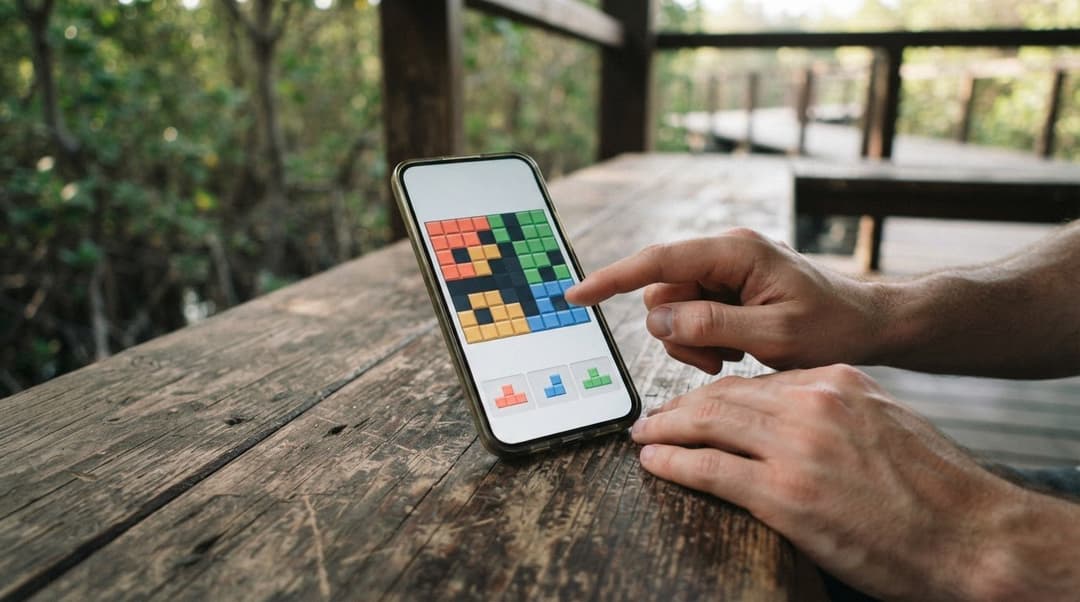
Rushing is a mistake, whether a round has a timer or not. The best fix for beginner mistakes in block puzzle games is to pause before each placement, scan the open spaces, and plan around every piece visible in your tray instead of chasing one quick clear.
It’s easy to focus on the piece in front of you and overlook what the next shape needs. Learn to handle rising difficulty, read each puzzle’s rules before committing, and choose moves that preserve useful space instead of boxing you in.
Use boosters deliberately, not in a panic. Pause, make the board work for you, and build a plan that still holds when space gets tight.
Key Takeaways
- Adapt as puzzles add new demands. Learn each mechanic before trying to solve the board at full speed.
- Compare every visible piece with the open spaces, then place the shapes that preserve the most useful options.
- Read the goal and rules before committing. A strong move depends on what that puzzle asks you to clear or protect.
- Save boosters for a clear purpose. Use one when it helps solve a specific board problem, not just because a move feels tense.
Table of Contents
- 1. Level thresholds and increasing difficulty
- 2. Planning the order of all visible tray pieces
- 3. Understanding the puzzle goal and rules
- 4. Using boosters instead of hoarding them
- Combo Rival: Combo Rivals: Block Puzzle (free mobile game)
1. Level thresholds and increasing difficulty
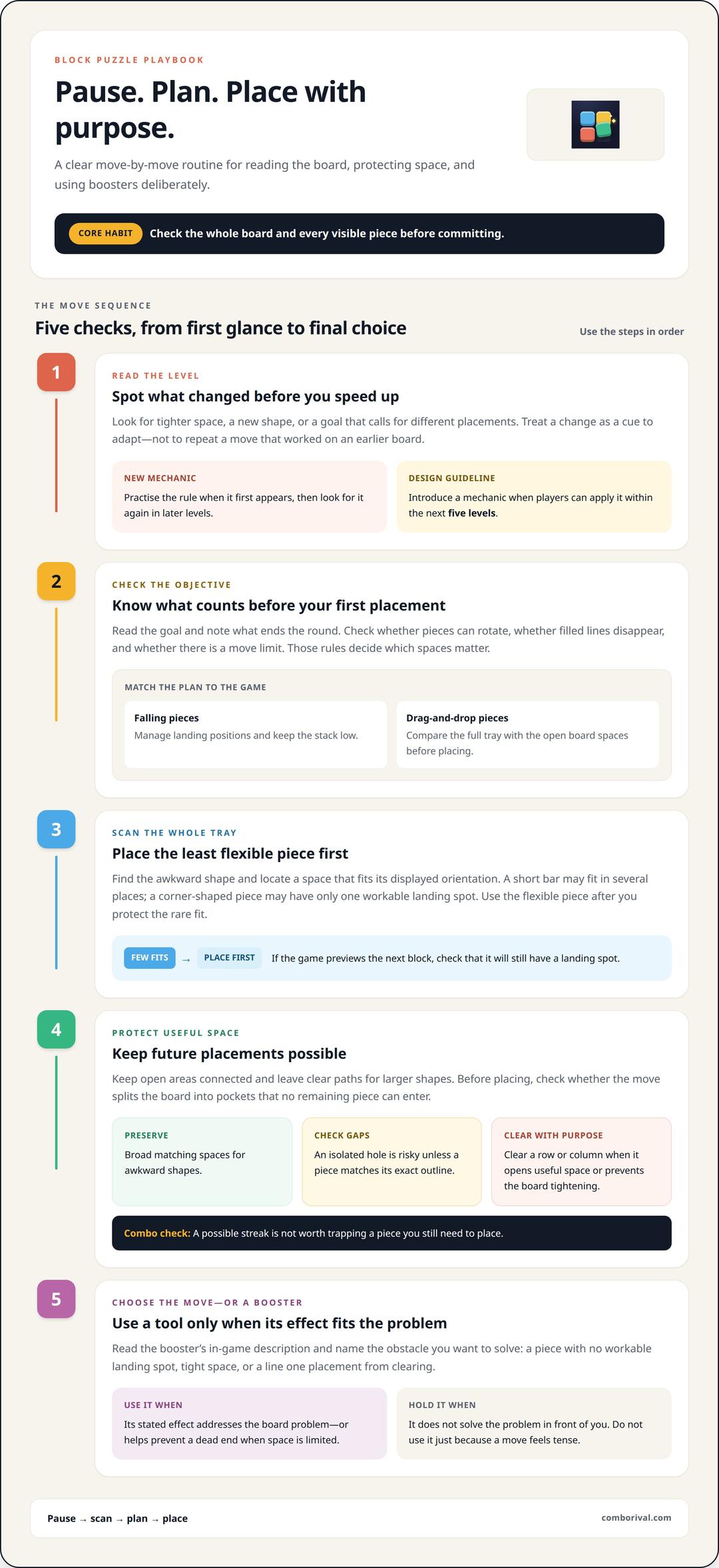
Difficulty should build in steps, not hit like a surprise wall. In a level-based puzzle, notice what changes from one board to the next: tighter space, a new shape, or a goal that calls for different placements. Treat that change as a cue to adapt, not to rush. A common beginner mistake in block puzzle games is repeating a move that worked earlier, even when the board now calls for a new approach.
When a puzzle introduces a mechanic, learn it before combining it with older challenges. A useful design guideline is to introduce a mechanic when players can apply it within the next five levels. You can use the same idea as a player: practise the new rule on its first appearance, then look for it again in later levels. Repeated mechanics make it easier to spot patterns instead of guessing.
Make each difficult level a small test. First, identify the new demand. Then compare it with the last board you cleared. If a level adds a narrow opening, for example, keep a matching space available rather than filling it with a convenient small piece. Subtle hints can point toward a useful move without giving away the whole solution. Pause when the board changes, and test one idea at a time.
Combo Rival uses a Color-blind-safe palette, with optional shape marks for each colour in Settings. If a puzzle offers difficulty choices, start with an option that gives you room to read the board and learn its mechanics. Focus on one skill, such as spotting open lines, before taking on a harder challenge. These choices support learning while keeping the core task of planning placements intact.
Difficulty also depends on whether a level has been tested from a new player’s perspective. Puzzle designers can use multiple playtesters to catch stages that feel too easy or too difficult for people who did not create them. As you play, separate a tough board from a rushed decision: review the available spaces, identify the level’s main constraint, and choose a move that keeps future options open. That habit scales as levels add pressure.
2. Planning the order of all visible tray pieces
Before placing anything, scan every piece in the tray. Find the awkward shape first, then look for board spaces that fit it in its displayed orientation. A short bar may fit in several places, while a corner-shaped piece may have only one workable landing spot. Place the piece with fewer options before the flexible one. This simple order keeps an easy shape from taking the only useful space.
To avoid running out of room, keep open areas connected and leave clear paths for larger shapes. Don’t fill a narrow gap just because a small block fits. Check whether the placement splits the board into pockets that no remaining piece can enter. For example, a single-block hole beside a filled edge can become dead space if the tray has no matching piece. Choose placements that preserve multiple possible fits.
Clear a row or column when doing so opens useful space or prevents the board from tightening. Hold out for a larger combo only if the setup leaves enough room for every visible piece. A possible streak isn’t worth trapping a piece you still need to place.
Isolated gaps are risky because they take up board space but rarely fit larger shapes. Before placing a block beside a hole, check whether a remaining piece matches that exact outline. If none does, avoid creating the gap unless the move clears a line or solves a more urgent space problem.
If the game previews the next block, use it to test your plan before placing the current piece. Ask whether the next shape will have a landing spot, then scan the rest of the tray again. For awkward shapes, preserve the broadest matching space and use flexible pieces to clear lines or fill open edges. Don’t assume you can rotate a shape; plan for its displayed orientation. This scan, fit, and place routine gives each move a clear purpose.
3. Understanding the puzzle goal and rules
Start each puzzle by reading its goal, then identify what ends the round. One board may ask you to clear lines; another may reward points or specific placements. Check whether pieces can rotate, whether filled lines disappear, and whether there’s a move limit. Those rules determine which spaces matter. A move that looks tidy can still miss the objective.
Strategies differ between Tetris-style and drag-and-drop games. In Tetris-style play, pieces fall, so manage their landing positions and keep the stack low. In drag-and-drop puzzles, you choose where each available piece goes, so compare the full tray with open board spaces before placing.
Scoring depends on the game’s rules. A puzzle may award points for placing blocks, clearing rows or columns, or making clears in succession. Read the score panel and watch what changes after a clear. If a combo appears, note which action triggered it and whether later clears extend the streak. Don’t assume another game uses the same scoring system.
Match your plan to the stated goal. If the task is to clear a line, prioritize placements that complete one without blocking the remaining pieces. If the goal is a high score, check whether the game rewards consecutive clears before attempting a risky setup. An incomplete line can be useful when you have a piece that can complete it.
Before your first move, confirm the goal, identify legal placements, and note how the round ends. Then make one move and observe the result. Did the line clear? Did the score change? Did the board refill? That first move gives you evidence about the mechanics. Keep the goal in view on every turn: a high score means little if the puzzle asks you to complete a different task.
4. Using boosters instead of hoarding them
A booster helps only when its effect matches the problem on the board. Before using one, read its in-game description and identify the obstacle you want to solve. Is a piece stuck, is space tight, or is a line one placement from clearing? If the booster doesn’t address that problem, save it and make a regular move instead.
Don’t save every booster for a perfect moment. In a puzzle with limited board space, a tool that prevents a dead end may be more useful now than later. If the game offers a way to change a piece, for example, consider using it when the current shape has no workable landing spot. Use the option only if its stated effect solves the problem and leaves room for the remaining pieces.
Set a simple rule before play: use a booster when it restores a legal move, protects a useful opening, or advances the stated goal. Skip it when a regular placement can do the same job. Comparing the two options helps you avoid spending a tool on a move that already works, and keeps panic from making the decision for you.
After using a booster, review the board and score. Did it create space, complete a line, or help meet the puzzle goal? If it didn’t change the problem, adjust your next decision. Booster effects vary by game, so rely on the displayed rules rather than assuming tools work alike. In Combo Rival, boosters are optional; planning doesn’t depend on buying a booster pack.
Practice the same decision process without rushing: identify the obstacle, read the tool’s effect, then compare it with a regular move. You can put your block puzzle strategy into play and focus on making each placement count. Keep the tool for a defined purpose, not just because the board looks crowded.
Combo Rival: Combo Rivals: Block Puzzle (free mobile game)
Put these planning habits to work in Combo Rival's block puzzle game. Try different placements, weigh each move, and develop your own rhythm without treating boosters as essential.
Ready to test your reads against a friend? Choose a live or anytime 1v1 friend duel. Both players start with identical boards and receive the same Shared piece sequence, so your choices shape the contest. Voice chat is available, with controls for players.
Prefer a solo challenge? Try the Daily puzzle and work through the board at your own pace. Combo Rival's Season Pass has free and premium tracks, and it's optional. Choose a mode that suits you, then put your sharper moves to the test in a friend duel. Download Combo Rival and start playing.
Make Your Next Move Count
Give your next round one clear focus. Practise a single habit, such as spotting a safe landing place before placing a tricky shape. Keep that focus through the game, then notice which choices preserved your options. It’s easier to assess each decision when you look at how it changed the board.
Avoiding beginner mistakes in block puzzle games isn’t about playing perfectly. It’s about choosing deliberately, learning from a tight board, and adjusting your next move instead of rushing to recover. Let each round sharpen one part of your approach, then carry that lesson into the next challenge.
Combo Rival brings block puzzle play to people who want to test their decisions. Take your time, trust your read of the board, and keep playing with purpose.
The Combo Rival team brings expertise to block puzzle play. Contact Combo Rival when you’re ready to take your next step. Enjoy the challenge, and make every move your own.
Frequently Asked Questions
Is there a timer forcing me to rush and make mistakes?
Some block puzzles use a countdown, while others let you take your time. Look for a visible timer before starting, and check whether it runs during every move or only certain stages. If there’s no clock on screen, focus on the board rather than inventing a deadline. In a timed round, practise recognizing familiar shapes so decisions come more quickly.
Should I save my boosters for later instead of using them?
Don’t save boosters automatically. First, learn what each one does in a low-pressure round, then decide whether you’re comfortable using it. This helps you avoid spending a tool without understanding its effect. Playing without boosters is a valid choice, too. Treat them as optional tools, not a requirement for learning or enjoying the puzzle.
What is the #1 block puzzle mistake beginners make?
A common mistake is assuming every block puzzle handles pieces the same way. One game may let you drag shapes freely, while another may use different placement controls or restrictions. Before a serious run, try a practice move and watch how the piece behaves. Learning the controls first helps prevent accidental placements that don’t reflect your strategy.
What are the most common beginner mistakes in block puzzle games?
Common missteps include tapping before positioning a piece, overlooking control cues, and expecting one familiar tactic to work in every mode. For example, someone switching from a falling-block game to a drag-and-drop puzzle may keep reacting to the last piece instead of using the new interface. Take a moment to learn the controls whenever you change modes.
Are there common power-up or booster mistakes in block puzzle games?
Yes. A frequent mistake is assuming a booster works the same way across games or modes. Its name or icon may not show every detail, so read the on-screen description before activating it. Avoid tapping several tools in quick succession, too. Use one at a time and observe the result to see what changed.